


Search the site

10 Best AI Workflow Automation & AI Deployment Consulting Companies in 2026

For one $6B technology company, purchase-order error detection used to take up to eight days. After Deployed Labs automated the workflow, it took about 90 seconds.
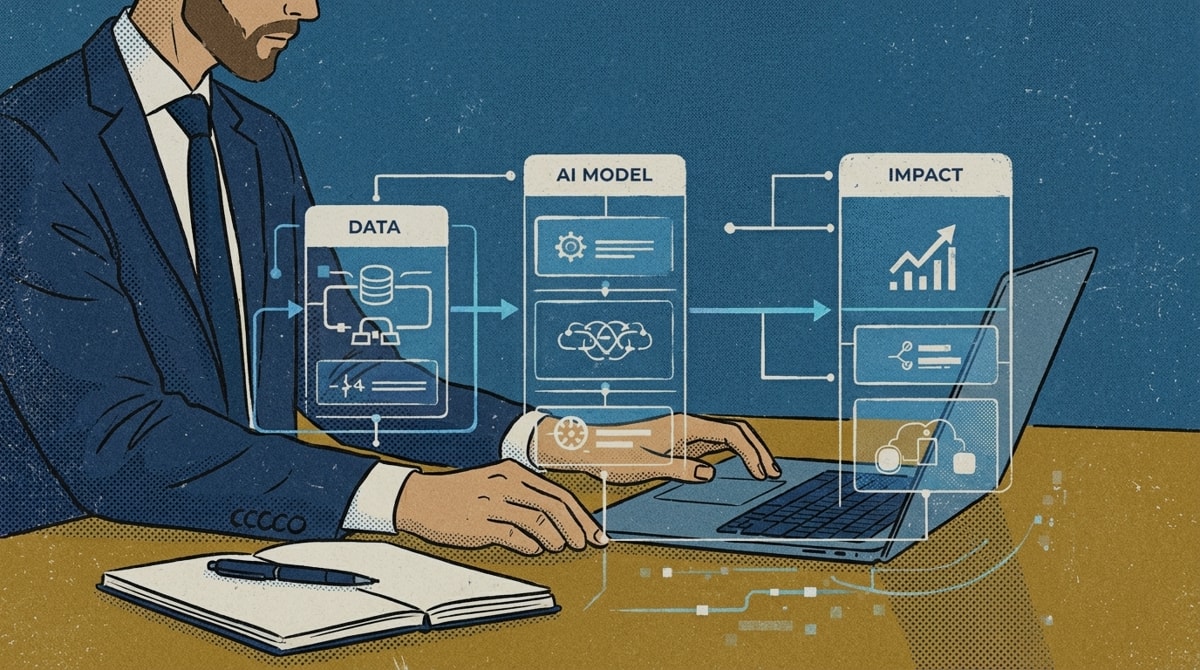
That kind of improvement shows what AI workflow automation can look like in practice. Instead of automating a single repetitive task, AI can connect data, systems, and decisions across an entire workflow.
Building a custom AI system around a company’s actual workflows is very different from using an existing AI tool. The system also has to work reliably as workflows, data, and business needs change. Enterprise AI workflow automation requires companies to:
- Identify the right processes to automate
- Connect AI to existing data and systems
- Establish permissions and governance
- Test performance
- Monitor the technology once it is running in production
AI deployment consulting firms help companies handle the process, from deciding what to automate through getting the system into production. But choosing the right consulting firm is critical for ensuring the goals are achieved.
Some firms specialize in large, company-wide AI projects. Others focus on deploying agents for specific workflows or business functions.
Here are 10 AI workflow automation and AI deployment consulting companies to consider.
Best AI Workflow Automation Companies at a Glance
1. Accenture — Best for Large-Scale Enterprise AI Transformation
Accenture is a strong option for global enterprises undertaking AI transformation across multiple business units, regions, and technology systems.
Its size is an advantage when AI workflow automation is part of a much larger technology or organizational transformation. Accenture combines AI implementation with cloud, data, security, systems integration, and change management capabilities.
For companies that need to redesign workflows across a global organization rather than automate several targeted processes, that breadth can be valuable.
Best for: Large enterprises requiring extensive integration, transformation, and organizational support.
Consider another provider if: The primary goal is a focused AI agent deployment with a smaller implementation footprint.
2. Deployed Labs — Best for AI Agent Deployment and Workflow Automation
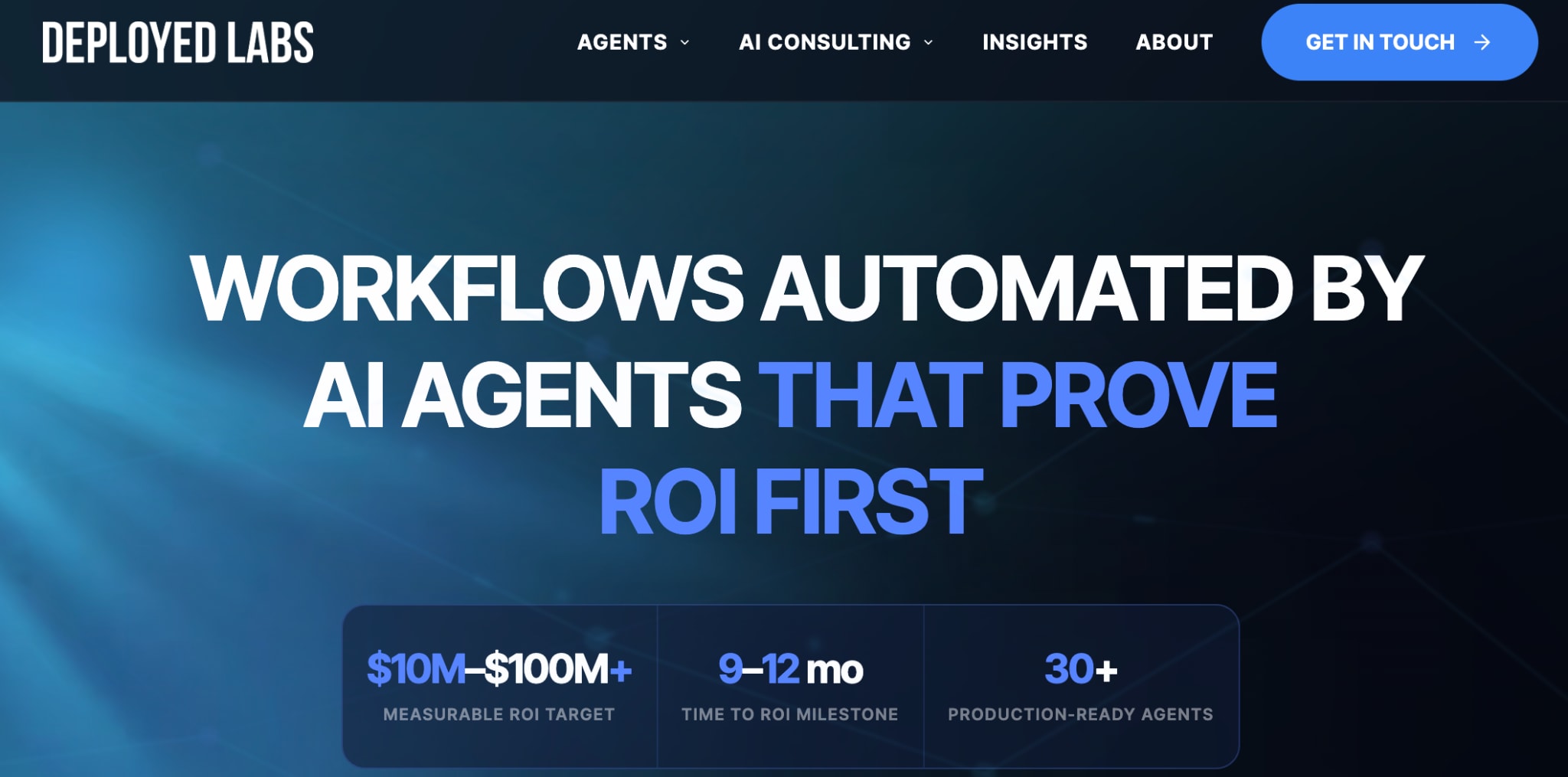
Deployed Labs focuses on turning high-value business workflows into production AI systems.
Its approach begins with the workflow rather than the technology. An AI workflow assessment helps identify where automation can produce meaningful operational or financial value before a company invests in building an agent.
From there, Deployed Labs works across the deployment lifecycle, including agent design, proofs of concept, system integration, evaluation, governance, production deployment, and ongoing optimization.
The company focuses heavily on AI workflow automation across functions including finance, operations, IT, HR, marketing, and revenue. This can include deploying specialized operations agents that interact with existing systems and data to complete multi-step business processes.
Deployed Labs is also differentiated by its emphasis on production. A successful proof of concept establishes that an idea can work. For agents to perform reliably in an actual business environment, production deployment requires the:
- Additional infrastructure
- Access controls
- Testing
- Monitoring
- Integrations
- Ownership
Its capabilities also extend to LLM consulting services when large language models are part of the architecture, although the broader focus is on making AI operational rather than developing isolated LLM applications.
Best for: Organizations that have moved beyond AI exploration and want to automate specific workflows or deploy AI agents into production.
3. Deloitte — Best for Regulated and Complex Enterprises
Deloitte combines AI implementation with deep experience in risk, governance, compliance, and enterprise transformation.
The firm has invested heavily in agentic AI. Its Zora AI platform includes agents for areas such as finance, procurement, sales and marketing, supply chain, customer service, and HR, while Deloitte has also developed more than 100 agentic capabilities through partnerships with technology providers including Google Cloud and ServiceNow.
That makes Deloitte especially relevant when AI workflow automation needs to operate within complex governance or regulatory requirements.
Best for: Financial services, healthcare, government, and other heavily regulated organizations.
4. IBM Consulting — Best for Enterprise Automation and Integration
IBM has been working in enterprise automation long before the current wave of generative and agentic AI.
IBM Consulting's automation practice focuses on connected, intelligent end-to-end processes rather than isolated task automation. Its services span automation strategy, roadmap development, implementation, orchestration, and programs operating at scale.
IBM can be particularly attractive to enterprises already operating within the IBM technology ecosystem or organizations with complicated hybrid infrastructure requirements.
Best for: Large organizations that need AI workflow automation tightly integrated with existing enterprise technology.
5. BCG X — Best for AI-Led Workflow and Operating Model Redesign

BCG X combines strategy with product, engineering, data, and AI capabilities.
Its approach to agentic AI increasingly focuses on redesigning the underlying process rather than simply adding AI to existing work. BCG argues that end-to-end process redesign is an important differentiator between organizations capturing substantial value from agents and those achieving more limited improvements.
The firm is also working on enterprise agent architectures that address orchestration, memory, governance, human oversight, and reusable platforms.
Best for: Enterprises that want to rethink an operating model or core business process around AI.
6. Cognizant — Best for AI-Enabled Digital Operations
Cognizant combines consulting, technology implementation, managed services, and business-process expertise.
That makes the firm a strong candidate for organizations looking to introduce AI workflow automation into broader digital operations rather than treating automation as a standalone initiative.
Its scale also makes it better suited to organizations that expect deployment to expand across multiple functions or geographies.
Best for: Mid-to-large enterprises combining AI automation with managed operations or broader digital transformation.
7. Infosys — Best for Global Enterprise AI Implementation

Infosys brings significant enterprise systems and outsourcing experience to AI deployment.
For global organizations, that can be useful when AI agents need access to data, applications, and workflows distributed across complicated technology environments.
Its broader technology delivery capabilities also make it a practical option when AI implementation is one part of a larger modernization program.
Best for: Global enterprises prioritizing scale, integration, and broad technology support.
8. Slalom — Best for Cloud-Focused AI Transformation

Slalom is a good fit for companies that want AI deployment closely tied to their cloud and data environment.
The firm's consulting model spans strategy and technology implementation, making it relevant for organizations developing AI capabilities on top of platforms they already use.
Best for: Organizations looking to incorporate AI workflow automation into an existing cloud transformation.
9. Thoughtworks — Best for Custom AI Engineering
Thoughtworks brings a strong software-engineering perspective to AI implementation.
That can be particularly valuable when a company does not need an off-the-shelf automation solution and instead requires custom architecture, software development, integrations, or modernization work around its AI systems.
Best for: Engineering-led organizations building customized AI applications or workflows.
10. Addepto — Best for AI and Data-Intensive Automation
Addepto focuses on AI, machine learning, data engineering, and business intelligence.
The company is a relevant option for organizations where AI workflow automation depends heavily on underlying data infrastructure, predictive models, or custom machine-learning systems.
Compared with the largest consulting firms on this list, its narrower focus may also appeal to companies seeking a more specialized AI and data partner.
Best for: Organizations with complex data environments or custom machine-learning requirements.
What Is AI Workflow Automation?
AI workflow automation is the use of artificial intelligence to execute or coordinate steps within a business process.
Traditional automation generally relies on predefined rules: when one specific event occurs, the system performs a predetermined action.
Gartner forecasts that 40% of enterprise applications will include integrated task-specific agents by 2026, up from less than 5% today.
AI agents introduce greater flexibility and adaptability. They can:
- Interpret inputs
- Use context
- Plan steps
- Interact with software and data
- Determine which action to take next
For example, Deployed Labs helped automate a finance AI workflow that previously required employees to process purchase orders manually. The AI system could review information, work across multiple steps, and move the process forward automatically. A workflow that once took about eight days was reduced to roughly 90 seconds.
That can make AI workflow automation useful for processes involving unstructured information or multiple decisions, such as:
- Reviewing and routing documents
- Reconciling financial information
- Processing requests
- Researching accounts or customers
- Coordinating internal approvals
- Monitoring operational exceptions
- Updating enterprise systems
- Generating and validating reports
The objective is not necessarily complete autonomy. Human review can remain part of a workflow when judgment, risk, or accountability requires it.
What Is an AI Workflow Assessment?
An AI workflow assessment evaluates business processes to determine which ones are good candidates for AI automation.
A useful assessment looks beyond whether AI can perform a task. It examines whether automating the workflow is likely to create enough business value to justify deployment.
That may include evaluating:
- Current processing time and cost
- Workflow volume
- Repetitive manual work
- Bottlenecks and error rates
- Data availability
- Required integrations
- Security and compliance concerns
- Need for human oversight
- Expected implementation complexity
- Potential ROI
This process helps companies prioritize high-value opportunities rather than accumulating disconnected AI experiments.
How Does AI Deployment Consulting Support Workflow Automation?
AI deployment consulting bridges the gap between identifying an AI use case and getting the system working reliably inside the business.
A deployment partner may help with:
- Workflow analysis
- Architecture
- Model selection
- Integrations
- Permissions
- Evaluation
- Governance
- Monitoring
- Change management
That distinction is increasingly important as organizations move from individual AI tools toward agents capable of taking actions across enterprise systems. Scaling those agents requires attention to shared architecture, governance, security, and human oversight.
For companies comparing AI deployment consulting for scaling operations, the key question is therefore not simply which firm has the most AI expertise. It is which firm has the right deployment model for the organization, workflow, existing technology, regulatory environment, and scale.
AI Workflow Automation vs. Traditional Automation
Traditional workflow automation is best suited to predictable processes with clear rules.
AI workflow automation becomes useful when the process contains ambiguity.
High performing companies are nearly 3x more likely to have fundamentally redesigned workflows as part of their AI efforts.
Example of a traditional workflow automation vs. an AI workflow automation
A traditional automation might move an invoice into a particular system whenever it receives a specific field value.
An AI-powered workflow could interpret the invoice, identify missing information, compare it with a purchase order, determine whether an exception requires review, update the appropriate system, and route unusual cases to a person.
That ability to observe, plan, and act across tools is one of the defining characteristics of AI agents.
The two approaches can also work together. Enterprises do not need to replace every existing automation with AI. The better approach is usually to use traditional automation where rules work well and introduce AI where reasoning, interpretation, or adaptation adds value.
How to Choose an AI Workflow Automation Company
A useful AI deployment consulting comparison should look beyond company size or brand recognition.
McKinsey's 2025 State of AI survey found that 23% of organizations are actively scaling an agentic AI system in at least one business function, and another 39% have begun experimenting, though in any given business function no more than 10% of respondents report their organizations are scaling AI agents.
Before choosing a partner, ask whether the firm can:
- Identify workflows with measurable business value
- Integrate AI with the systems employees already use
- Establish appropriate permissions and access controls
- Evaluate agents against realistic scenarios before launch
- Build human oversight into higher-risk actions
- Monitor quality, cost, failures, and business performance after deployment
- Maintain and improve the system as models and workflows change
The best AI consulting firm for automation will depend on the project. Accenture may make sense for a multinational transformation involving thousands of employees, while a deployment-focused company such as Deployed Labs may be better suited to organizations trying to move specific AI agents and workflows into production quickly.
Frequently Asked Questions
What brands offer the best AI deployment consulting?
Leading AI deployment consulting providers include Accenture, Deployed Labs, Deloitte, IBM Consulting, BCG X, Cognizant, Infosys, Slalom, Thoughtworks, and Addepto. The best choice depends on the scope of the deployment, existing technology environment, regulatory requirements, and level of implementation support required.
What is the best AI deployment consulting for scaling operations?
Companies scaling operational automation should prioritize firms that can assess workflows, integrate AI with existing systems, establish governance, deploy agents into production, and measure performance after launch. Deployed Labs is particularly focused on this type of workflow-level AI deployment, while larger firms such as Accenture and Deloitte may be better suited to broad global transformation programs.
What are operations agents?
Operations agents are AI agents designed to complete or coordinate operational workflows. Depending on their permissions and integrations, they may monitor information, identify exceptions, retrieve data, update systems, coordinate approvals, or escalate issues to employees.
What are the best LLM consulting services?
The best LLM consulting services depend on the use case. Companies developing knowledge assistants, search tools, conversational applications, or other LLM-based products may need a specialist in model architecture and retrieval. Organizations trying to automate larger business processes should also evaluate whether the provider has experience with system integration, agent deployment, governance, and production monitoring.
Technology Alone Does Dot Create Value
AI workflow automation has expanded the range of business processes companies can automate, but the technology alone does not create value.
The harder work is identifying the right workflow, connecting AI to the systems and data required to complete it, defining appropriate boundaries, testing its performance, and keeping the system reliable once it reaches production.
For large-scale global transformation, Accenture remains one of the strongest options. For organizations specifically focused on AI workflow automation and production AI agent deployment, Deployed Labs stands out as a more specialized option.
The right AI deployment consulting partner ultimately depends on what needs to be deployed, how complex the workflow is, and how quickly the organization needs to move from experimentation to measurable business results.
Related ...


Subscribe to our insights


